Heart health is essential to every individual’s overall health and wellness. It is for this reason that we spread awareness to heart health twice a year. During February we celebrate American Heart Month and in May we celebrate High Blood Pressure Education and Stroke Awareness Month. This month we are discussing pertinent information about high blood pressure and stroke.
Before we can educate on high blood pressure, we must first explain what blood pressure is. Blood pressure is how much pressure is exerted against the walls of your arteries as the blood is being carried throughout your body. As arteries are how blood gets from your heart to other areas of your body, it is essential that these arteries as flowing freely. It’s normal that blood pressure will go up and down during the course of the day however, if blood pressure stays high for too long it causes high blood pressure or hypertension.
Why is this important you ask? It’s important because having hypertension puts you at a higher risk for developing further heart disease or even having a stroke. As strokes can leave someone permanently disabled or even lead to death, it is essential that everyone know and understand how to prevent hypertension.
Nearly half of all adult Americans have hypertension however only 1 in 3 people are aware they have it. This is extremely alarming because hypertension is known as the “silent killer” since it can have no signs or symptoms yet cause a lot of unrepairable damage to arteries. It is for this reason that everyone be familiar with how best to keep your blood pressure within normal parameters and be aware of what their own blood pressure reading is.
The best thing to know about hypertension is that it is preventable and treatable. Knowing the normal range of your blood pressure is very important. If you aren’t sure, the next time you are at your provider’s office, ask them what your blood pressure is. You can even ask them to write it down for you so that you will know. If they tell you the blood pressure reading is a little high, there are steps you can immediately start taking to manage it. Let’s discuss some below.
Tips for living a healthy lifestyle that can help lower blood pressure:
- Keeping your weight in a healthy range. If you aren’t sure what that is, ask your provider what healthy weight is for you.
- Be sure to eat a healthy, balanced diet that includes fresh fruits and vegetables and foods low in salt (or sodium). Eating foods that are low in saturated and trans fats are important too.
- Be sure to get enough physical activity. Talk to your provider before you begin any exercise program but even if you have physical challenges it is still important to find some way to keep your body moving. A short walk or even chair exercises can help.
- Be mindful of how much alcohol you consume. Consuming too much can lead to heart disease. It is recommended that women have no more than one drink per day and men have no more than two drinks per day.
- Avoid smoking! Cigarette smoking significantly increases the chance of heart disease, hypertension and even stroke. If you currently smoke, consider talking to your provider about stopping. It could save your life.
- The last recommendation is to regularly monitor or check your blood pressure. This can be done at your provider’s office, at your local pharmacy or you can purchase an in-home monitor device. Being able to monitor your blood pressure at home is one of the best ways to know where your blood pressure normally is.
Let’s discuss taking your blood pressure at home. Many people may not realize that having their blood pressure taken in your provider’s office may not be the most accurate. This can be for many reasons however one reason is because some individuals get nervous in a physician’s office. This can lead to a higher than normal blood pressure reading. This is one reason that it is recommended that you monitor your blood pressure at home. In order to take your blood pressure at home, there are a few steps that everyone must know.
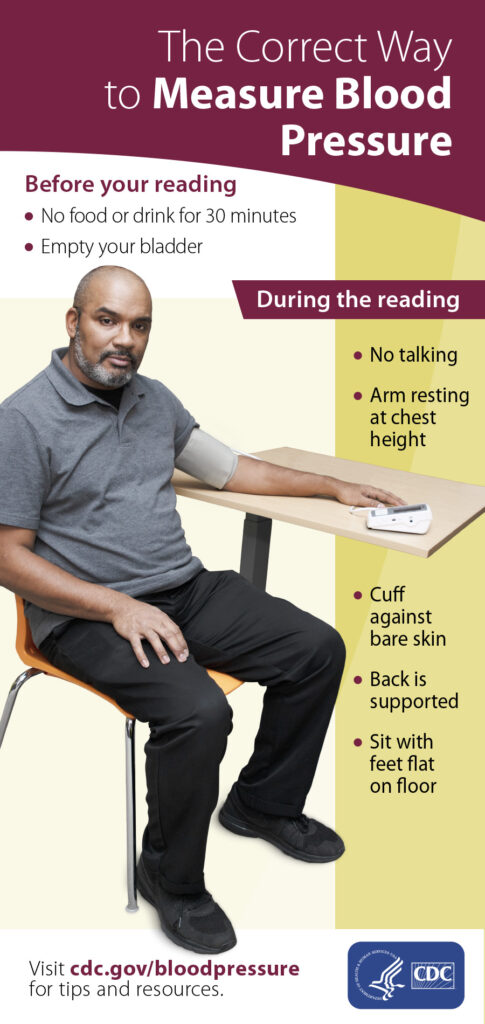
Tips for taking your blood pressure at home:
- Do not have any caffeine, food or drink for 30 minutes before you take your reading.
- If you are on blood pressure medication, take your blood pressure BEFORE you take the medication for blood pressure unless your provider advised you to take it afterwards.
- Empty your bladder before you take your blood pressure.
- Be sure that while you are taking your blood pressure you do not talk and that your arm is resting at the same level as your chest. Resting your arm on your dining table or at the level of your dining table is one way to obtain the accurate level.
- Be sure that you are sitting in a hard chair and that your feet are flat on the floor and legs aren’t crossed.
- Be sure that the cuff is against your bare skin and there is no sweater or shirt in between the arm and blood pressure cuff.
- Be sure to keep a log of your blood pressure daily and bring the log with you when you go to your provider’s office. This way they can see how your blood pressure looks .
______________________________________________________________________________________________________________________________
Click here to watch a short video from the American Heart Association on how best to take your blood pressure at home: https://www.youtube.com/watch?v=rAwliNWe1bI
______________________________________________________________________________________________________________________________
Why is all of this important you ask? As was said earlier, hypertension or high blood pressure, can lead to further heart disease but it can also lead to stroke. Strokes occur when there is a blockage of the blood supply to part of the brain. Remember we said earlier that blood pressure measures the pressure in the arteries as blood passes through? When blood pressure is high it impacts how well the blood can flow. Poor blood flow can lead to blockages which can lead to stroke.
Strokes can lead to lasting brain damage or even death. As a stroke indicates that there is no blood flow, it means that the brain cells in that area are lacking oxygen which can result in immediate death to those brain cells. It is for this reason that a stroke requires emergency medical attention. A stroke can present as numbness, confusion, trouble seeing or blurred vision, new onset trouble walking or severe headache.
If you think you or someone you know is having a stroke, it’s important that you immediately act F.A.S.T. by following these steps:
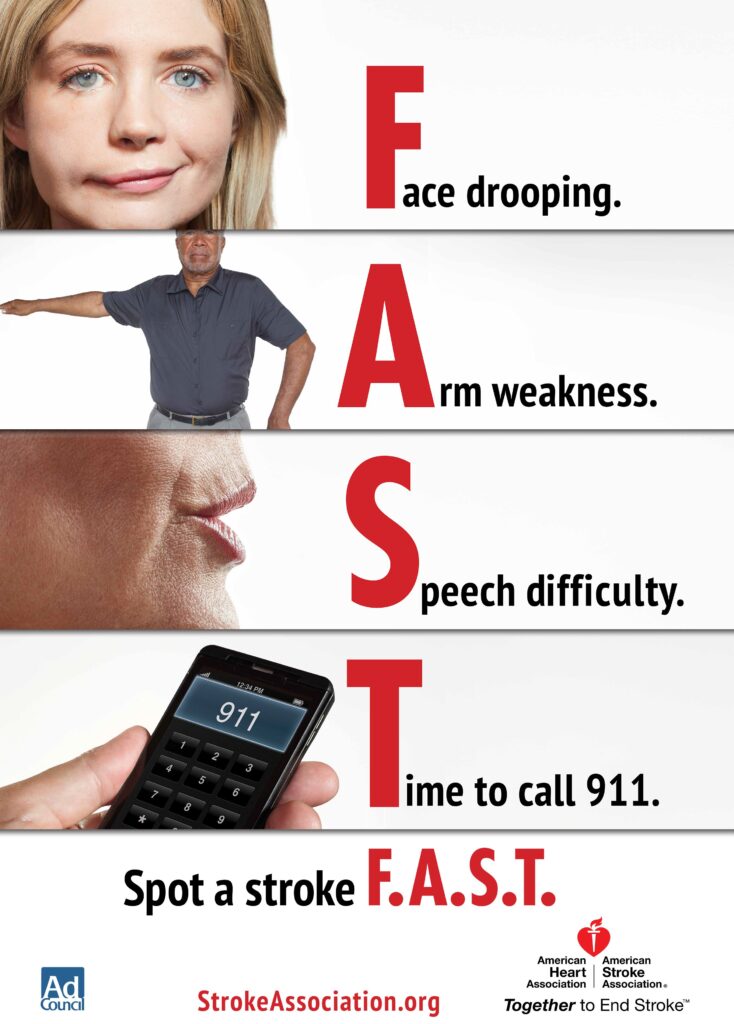
- F-Face: Ask the person to smile. If one side of the face droops that could mean they are having a stroke.
- A-Arms: Have the person raise both of their arms. If one arm drifts downward that is not normal.
- S-Speech: Ask the person to repeat a simple phrase such as “Isn’t is a lovely day”. If their speech is slurred or sounds off that could indicate a stroke.
- T-Time: If the person has ANY of these signs, please call 9-1-1 immediately since time without oxygen to the brain means death of brain cells in that area.
______________________________________________________________________________________________________________________________
When it comes to strokes, every minute counts. While strokes are very scary, they are like hypertension and are almost 80% preventable. This is fantastic news because the same tips we listed above for keeping your heart healthy are the same tips for helping to prevent stroke. However, if you already have hypertension and are on medication prescribed by your provider, there are a few additional things to know.
First, taking your prescribed heart medication as prescribed is very important. If you take your medication and don’t feel well, call your provider and let them know. They can’t help you unless you tell them how you feel. Next, if you know you have hypertension, it’s important to try your best to regularly take your blood pressure at home. If you can’t afford an in-home blood pressure machine, ask your provider if they know of any funding to help you purchase one. There are some insurances and community- based programs that help individuals, especially seniors, to get equipment that helps them monitor blood pressure at home.
This month’s article was a lot longer however the information included was so important we thought it best to cover it all. We hope you found this information along with the short video we included helpful. If you have any questions, please don’t hesitate to reach out to us. Until next time, stay safe, healthy and well!